

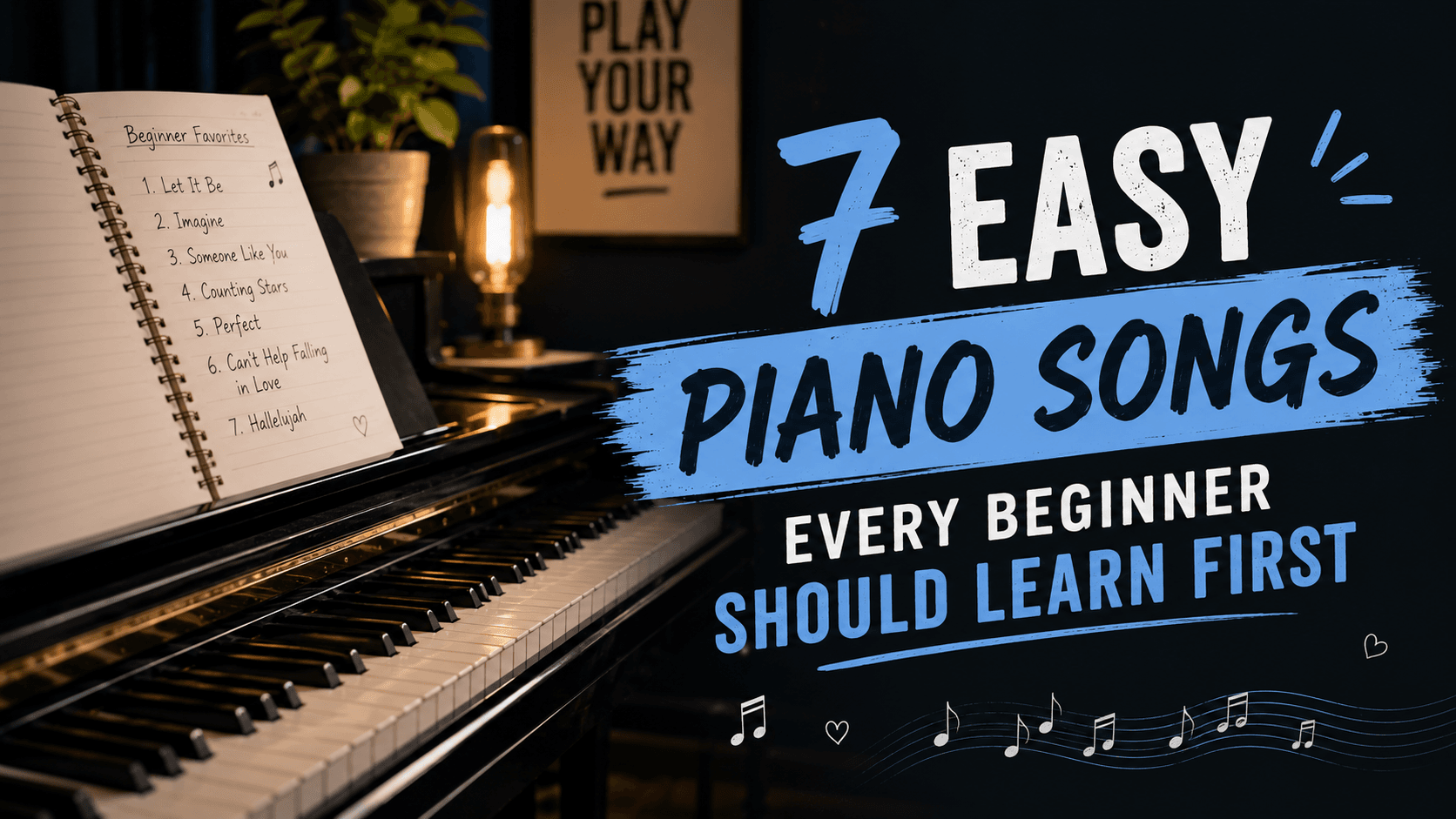
7 Easy Piano Songs Every Beginner Should Learn First
Exercises build technique, but songs build pianists. Nothing keeps a beginner practising like working on music they actually recognise – and the piano repertoire is full of famous pieces that are far more learnable than they sound.
The seven songs below were chosen for beginner piano lessons with three things in mind: each one is recognisable, each is genuinely achievable in the first year, and each teaches a skill you’ll use forever.
What Makes a Piano Song Beginner-Friendly?
The best beginner pieces share a few traits. The left hand plays something simple and repetitive, so it can run on autopilot while the right hand carries the melody. The structure repeats, so learning one section unlocks most of the piece. And the tune is familiar, which means your ear catches mistakes instantly – free feedback with every play-through.
The 7 Songs
1. Ode to Joy – Beethoven
The classic first piece, and for good reason. The melody moves mostly by step, sits comfortably under five fingers, and is instantly recognisable. Learn the right hand first, then add a simple left-hand accompaniment. It’s usually taught in C or G major, keeping everything on the white keys and close under the hand. It’s the fastest route from “learning piano” to “playing Beethoven” in existence.
2. Heart and Soul – Hoagy Carmichael
The famous duet everyone has heard someone plonk out on a public piano. Its left-hand pattern is one of the most common chord progressions in popular music, so learning it here means recognising it in hundreds of songs later. It’s also a genuine duet – perfect for playing with a parent, sibling or friend. In C major, the pattern cycles through C, A minor, F and G – four chords you’ll meet again and again.
3. Let It Be – The Beatles
Four chords in the left hand, a steady singable melody in the right. Let It Be teaches the fundamental pop-piano skill: holding chords in one hand while the other carries the tune. Once it clicks here, a huge amount of popular music opens up using the exact same shapes. The chords are C, G, A minor and F – the same four as Heart and Soul, in a different order, which is no coincidence.
4. Für Elise (Opening Section) – Beethoven
The full piece is intermediate territory, but the famous opening section – the part everyone knows – is very manageable early on. It teaches gentle hand alternation and a light, controlled touch, and it sounds far more impressive than the effort it requires. Excellent value for beginner bragging rights. The opening is built on a gentle rocking two-note figure and simple A minor arpeggios, so it lies naturally under the fingers.
5. Someone Like You – Adele
The piano part is built on a repeating broken-chord pattern in the right hand that, once learned, simply cycles through the song. It’s brilliant training for evenness and rhythm consistency, and simplified arrangements are everywhere. Slow it down, get the pattern smooth, and speed comes on its own. The song cycles the same four chords throughout, and simplified arrangements often move it into an easier key for new players.
6. Clocks – Coldplay
One of the most recognisable piano riffs of the modern era, and it’s a single repeating broken-chord figure. Clocks teaches syncopation – notes that land off the beat – in the most enjoyable way possible. Learn the riff slowly and evenly first; the distinctive rolling feel emerges as it speeds up. The pattern rotates through just three chords, and beginner arrangements commonly transpose it into a friendlier key.
7. River Flows in You – Yiruma
The modern favourite that brings many adult beginners to the piano in the first place. Simplified arrangements capture its flowing arpeggios and gentle melody while staying achievable, and it’s a beautiful introduction to using the sustain pedal. If your goal is to play something that makes the room go quiet, this is it. The left hand settles into a repeating arpeggio pattern while the right carries the melody – a fair division of labour once the hands have met in easier songs first.
Tips for Learning These Songs
Take them one at a time – depth beats breadth for building skills. Learn hands separately before putting them together, and practise slowly with a metronome before chasing full speed; slow and correct always wins the race over fast and scrappy. Use simplified arrangements without guilt: they’re a legitimate stepping stone, and the full versions will still be there when you’re ready.
A teacher will also sequence these to match your level and catch technique issues early – if you’re wondering where each song fits in the journey, our guide to how long it takes to learn piano maps the typical timeline. And if the household is torn between instruments, we’ve made the same list for guitarists: easy guitar songs for beginners.
Practising at Home
Progress lives in the days between lessons, which means having something to practise on. You don’t need a grand piano – a keyboard with touch-sensitive, ideally weighted keys will carry you a long way. Our piano and keyboard buyer’s guide covers what to look for at every budget, and Manhattan Music’s take-home lay-buy system can help with the upfront cost.
Learn Them Properly From the Start
Every song on this list is more satisfying – and learned faster – with a teacher guiding technique, fingering and rhythm from day one. Manhattan Music School in Eltham North has been teaching students of all ages across Melbourne’s Northern Suburbs for over 20 years, and our accredited teachers love building lessons around the music students actually want to play.
Call us on (03) 9439 4800 or explore piano tuition at Manhattan Music to book a trial lesson.