

Understanding Time Signatures for Drummers
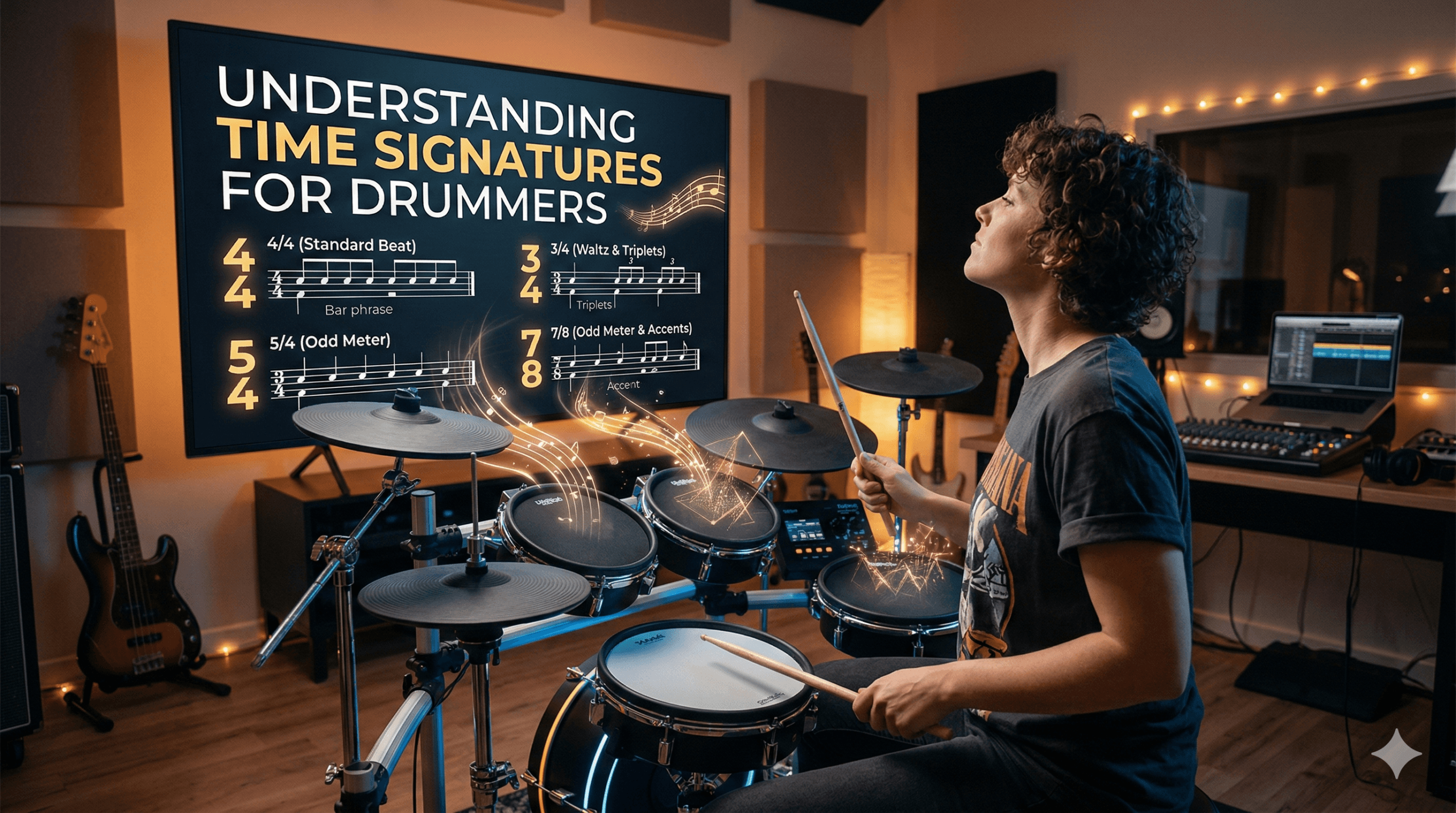
Time signatures are one of those topics that sounds more complicated than it is. For drummers especially – whose entire role is built around rhythm and structure – understanding time signatures is less about music theory and more about feeling the pulse of a song.
This guide breaks it all down in plain language, with no jargon and no assumption that you’ve studied music formally. If you’ve already started exploring drum lessons at Manhattan Music, you’ve likely encountered these concepts already. This article will help them click.
What Is a Time Signature?
A time signature is simply a way of describing the rhythmic structure of a piece of music — how many beats are in each bar, and what kind of note gets one beat.
You’ll see time signatures written as two numbers stacked on top of each other, like a fraction. The top number tells you how many beats are in each bar. The bottom number tells you what type of note gets one beat.
The most common bottom number is 4, which means quarter notes. You don’t need to know exactly what a quarter note is — just understand that the bottom number tells you the “unit” of the beat, and the top number tells you how many of those units fit in a bar.
Let’s look at the most common time signatures you’ll encounter as a drummer.
4/4 — Common Time
If there’s a default time signature in popular music, it’s 4/4. The vast majority of rock, pop, hip-hop, jazz, and country you’ll ever hear is in 4/4.
It means four beats per bar, each a quarter note. You count it: 1, 2, 3, 4 — 1, 2, 3, 4.
As a drummer, 4/4 is where most grooves live. The basic rock beat, the shuffle, the funk groove — all of them sit comfortably in four-four. It’s the time signature that feels most natural to most people because so much of the music we grow up hearing is built on it.
Beginner beats to try these signatures with are mostly in 4/4, making that article a practical companion to this one.
3/4 — Waltz Time
Three-four time has three beats per bar instead of four. You count it: 1, 2, 3 — 1, 2, 3.
The name “waltz time” gives you a feel for how it moves — there’s a lilt and a sway to it, a slight emphasis on beat 1 followed by two lighter beats. Think of a carousel or a formal dance. The pattern isn’t square and even like 4/4; it tips slightly in one direction.
Musically, 3/4 appears in classical waltzes, folk music, and some pop and rock songs. “My Favourite Things” from The Sound of Music is in 3/4. So is “Take It to the Limit” by the Eagles. As a drummer, you’ll play it with a snare on beat 3 (rather than 2 and 4 as in 4/4), which takes a little adjustment.
6/8 — Compound Time
This is where beginners often get confused, because 6/8 can feel similar to 3/4 but is counted and felt quite differently.
Six-eight has six beats per bar, and the bottom number 8 means eighth notes get the beat. You count it: 1, 2, 3, 4, 5, 6 — 1, 2, 3, 4, 5, 6. But in practice, most musicians feel it as two groups of three rather than six individual beats — a strong beat on 1 and a secondary emphasis on 4.
Where 3/4 feels like a waltz (one strong beat, two lighter ones), 6/8 feels more fluid and rolling — almost like a wave. Slow rock ballads often use 6/8 to create that emotional, swelling quality. Irish traditional music uses it extensively. “House of the Rising Sun” by The Animals is a classic 6/8 example. So is “We Are the Champions” by Queen.
As a drummer, 6/8 opens up interesting possibilities with how you practise rudiments in different time feels — breaking out of 4/4 makes your technique noticeably more flexible.
The Difference Between 6/8 and 3/4
This trips up a lot of people, so it’s worth being clear. Both have six eighth notes per bar when you do the maths, but they feel completely different.
In 3/4, you feel three beats per bar. The emphasis is even and predictable: ONE, two, three, ONE, two, three.
In 6/8, you feel two beats per bar (each divided into three). The emphasis is: ONE-two-three, TWO-two-three. It’s compound and rolling rather than simple and even.
The simplest test: if a song makes you want to waltz, it’s probably 3/4. If it makes you want to sway like a boat on water, it’s probably 6/8.
Odd Time Signatures: A Brief Look
Most popular music stays in 4/4, 3/4, or 6/8. But plenty of well-known songs venture into what musicians call “odd time” — time signatures with asymmetrical groupings that don’t divide evenly into familiar patterns.
5/4 has five beats per bar. You feel a slight awkwardness compared to 4/4 — one extra beat that keeps things off-balance in an interesting way. The most famous example is the theme to “Mission: Impossible” — that lurching, tense rhythmic feel is entirely due to the 5/4 time signature.
7/4 (and 7/8) have seven beats per bar, creating an even more complex feel. “Money” by Pink Floyd is a well-known 7/4 example. The irregular, slightly circular pattern keeps the listener slightly on edge in a way that serves the song’s atmosphere perfectly.
As a beginner, you don’t need to master odd time straight away. But understanding they exist — and recognising them when you hear them — is part of becoming a well-rounded musician.
Practical Counting Tips for Drummers
Count out loud when learning a new time signature. Saying “1, 2, 3, 4” or “1, 2, 3” while you play forces your brain and body to stay aligned. Most students stop counting too early, before the pattern is automatic.
Tap your foot on beat 1 regardless of what time signature you’re in. That anchor point keeps you from losing your place when patterns get more complex.
Listen actively. The next time you’re in the car or listening to music, try to count the beats per bar. Most songs will land in 4/4 almost immediately. When one doesn’t, you’ve found something interesting — pay attention.
Work on feel, not just mechanics. Time signatures are ultimately about rhythm and groove, not mathematics. If your counting is correct but your playing feels stiff, slow down and let yourself feel the pulse of the bar before you worry about the pattern on top of it.
For choosing the right drum kit to practise all of the above at home, our acoustic vs. electronic comparison article is worth reading before you invest.
Book a Lesson at Manhattan Music
Understanding time signatures in theory is just the beginning. Applying them under guidance — with an experienced teacher correcting and shaping your feel in real time — is where the real learning happens.
Manhattan Music School has been teaching drummers of all ages in Melbourne’s Northern Suburbs for over 20 years. Our teachers are AMEB, Rockschool, and ANZCA accredited, and we welcome students from age 5 to 91.
Visit our drum lesson page or call us on (03) 9439 4800 to book a lesson at our Eltham North studio.